
For two years, every customer I asked said the same thing: fine. The clean was fine. The crew was fine. Everything was fine. And for two years, regulars I had cleaned for since the beginning kept cancelling their bookings without a single word of explanation. My feedback said I was doing great. My calendar said I was slowly losing.
Who I am
My name is Rosa. I run a small house-cleaning company - a handful of crews, two vans with our logo peeling slightly on the left side, and a kitchen table that doubles as head office. I started it after years of cleaning other people's homes for somebody else's company, promising myself that when it was my name on the van, nobody would ever feel like just a booking number.
It is a lonely kind of business to run. My crews see the customers. I see invoices, schedules and a phone that never stops. I am rarely in the room when a customer opens the door and decides whether we did a good job. So the only way I can know if my promise is being kept is if people tell me. And for a long time, nobody told me anything useful at all.
The Tuesday I almost gave up on asking
The moment I remember is a Tuesday evening. A family I had cleaned for every other week for almost three years sent a two-line email. They would not need us anymore. Thank you for everything. No reason.
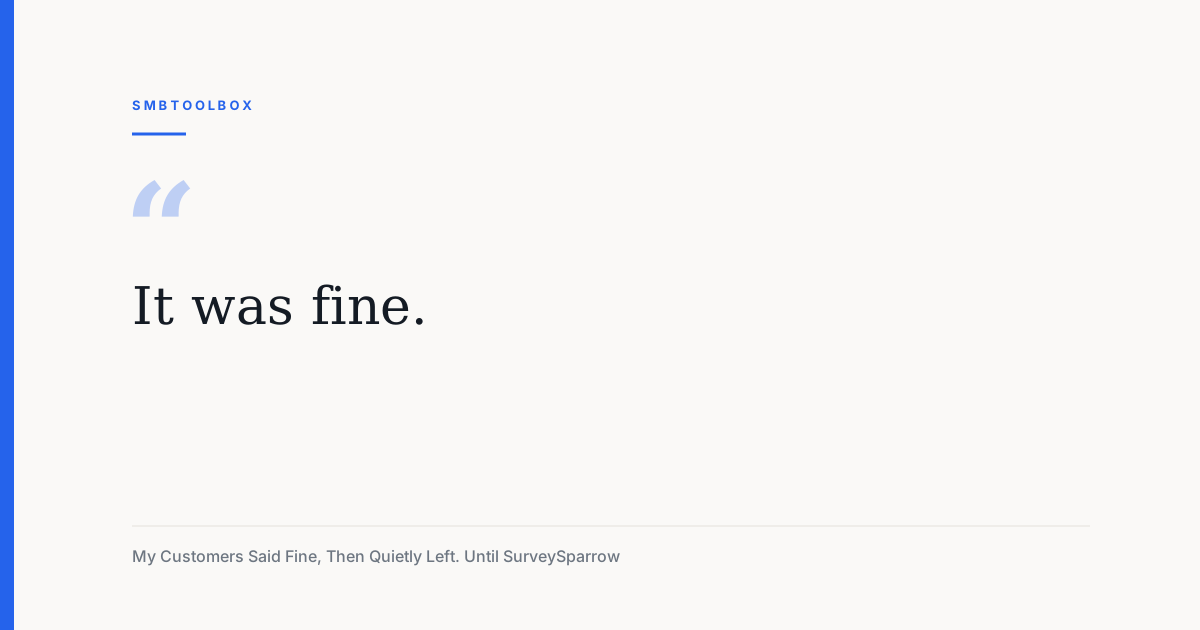
I went straight to my spreadsheet of survey replies, because I was sure there would be a clue. There was. Their last response, from six weeks earlier, in its entirety:
It was fine.
Four stars. It was fine. I sat at the kitchen table and scrolled through dozens of other answers and realised almost all of them looked the same. Fine. Good. OK. No complaints. I had been collecting feedback for two years and I had learned precisely nothing from it. Somewhere between fine and cancelled there was a real story, and I was never going to hear it.
What I tried (and why it failed)
I am stubborn, so before I blamed my tools I blamed myself and tried harder.
- A long, thorough form. Fourteen questions about punctuality, products, attention to detail. I was proud of it. Almost nobody finished it, and the few who did clearly clicked the middle option all the way down just to make it stop.
- A single rating question. Easy to answer, so more people answered - and I got a lovely column of numbers with no reasons attached. A three out of five tells you something is wrong. It does not tell you what.
- Calling customers myself. The most honest option and the least scalable. People are polite on the phone. They said it was fine, to my face, and I believed them, and then some of them left anyway.
What all three had in common was that the conversation ended the moment the customer gave their first answer. A real person would have asked the obvious next question: fine how? My forms never did.
The turning point
I found SurveySparrow while searching, slightly desperately, for some way to make people actually explain themselves. The headline on their homepage stopped me, because it was my exact problem written by somebody who had never met me: Stop guessing why customers are unhappy.
I was sceptical. The page talks a lot about AI, and I am a cleaning company owner, not a data team. Their customer logos include names like DHL, Siemens and Volkswagen, and my first thought was that this was built for businesses a thousand times my size. But one line kept pulling me back:
Every response becomes a conversation.
That was the whole thing I had been missing. They also say there is a free plan with no credit card required, so trying it cost me an evening rather than a decision. I rebuilt my old form, sent it to a small group of regulars, and went to bed not expecting much.
The next morning I read a reply from a customer who had rated us three stars. Underneath, where there would normally have been nothing, there was a follow-up question and a proper answer. Paraphrasing only slightly: the crew was lovely, but lately they had been rushing the upstairs bathroom, and she had not wanted to make a fuss about it. I actually got chills. That was the sentence the family who left would never have typed into my old form.
How I actually use it
I am not using every part of the platform, and I will not pretend to. The homepage covers surveys, NPS software, customer feedback, forms, pulse surveys, market research, an employee success platform and 360-degree assessments. For a business my size, these are the pieces that earn their place.
Getting past fine: follow-up questions
- Echo AI is described as asking contextual follow-ups to uncover the real truth. For me: this is the heart of it. When somebody gives a lukewarm answer, the survey asks about it instead of politely moving on.
- For me: it means I can keep the survey short at the start, which gets people in, and still end up with the detail that a fourteen-question form never got me.
Actually getting replies
- SmartReach AI is pitched as reaching the right person, at the right time, on the right channel, and deciding how each survey is delivered, automatically for each contact. For me: I stopped trying to guess the perfect moment to send a survey to a busy parent. The homepage claims up to 40 percent higher response rates - I cannot promise you that number, I can only tell you my inbox stopped feeling like an empty room.
- SpotChecks are described as capturing feedback at the exact moment it happens, with behaviour-triggered, context-aware surveys. For me: that matters most on our website, where people book, because the moment a question comes up is the moment they are most likely to answer honestly.
Making sense of the answers without a spreadsheet
- Enrich AI turns free-text answers into tags, categories and metrics, with sentiment tagging and keyword extraction. For me: I no longer read two hundred comments trying to spot a pattern at midnight.
- CogniVue promises to show patterns, not spreadsheets - theme detection, key driver analysis and emerging trend alerts. For me: this is how I would have caught the rushed bathroom problem across several homes before it cost me a family.
- Co-Pilot lets you ask your data anything and get instant summaries. For me: I ask it the plain-English questions I would ask a business partner if I had one.
Listening to my own crews
- Pulse surveys and the employee side of the platform. For me: the people who know why a job ran late are my crews, and I had never once asked them properly. Now I do.
- Forms for registrations, lead capture and quizzes. For me: a simple quote request form that lives in the same place as everything else, instead of in yet another tool.
It also lists integrations with tools a lot of small businesses already use, including Zapier, Slack, HubSpot, Mailchimp and Stripe, and the security badges on the homepage - SOC 2, ISO certified, HIPAA and GDPR compliant - were a quiet relief for somebody who holds door codes and home addresses for a living.
The results that mattered
I am not going to give you a dramatic chart, because the honest truth is that the change was quieter than that, and more important.
The word fine mostly disappeared from my replies. In its place came reasons - small, specific, fixable things. A product scent a customer disliked. A crew arriving at a time that clashed with a school run. A dog who was frightened of the vacuum and an owner who was too embarrassed to mention it. None of these would have ended up in a complaint. Every one of them could quietly have ended up in a cancellation.
I fix them now, usually within the week. My crews know what customers love about them by name, which has done more for morale than any bonus I could afford. And when somebody does leave, I almost always know why - which, strangely, hurts much less than not knowing.
Isn't this a bit much for a small business?
That was my biggest doubt, and I think it is a fair one. The homepage is clearly speaking to large companies too, and there are a lot of named AI features to get your head around. Echo, SmartReach, SpotChecks, CogniVue, Co-Pilot, Enrich, Wing - on the first evening I felt like I needed a glossary.
What changed my mind is that I do not have to use all of it. I started with one short customer survey and the follow-up questions, and added pieces only when I had a real reason. If you only ever use the part that turns fine into an actual answer, it is still doing the job I needed.
The other doubt: is it pushy to ask customers follow-up questions? I worried about that too. In practice, people seem to like being asked a sensible second question far more than being handed a long list of first ones. It feels like somebody is listening, because somebody is.
One practical note: I am deliberately not quoting prices here, because plans change. Check the current plans on their site for yourself before you commit, and start on the free plan if it covers what you need.
The new me
I used to open my feedback spreadsheet with a knot in my stomach, looking for reassurance and never quite finding it. Every fine felt like a door politely closing in my face.
The Rosa running this business now does not guess. When a customer is unhappy, I find out while there is still time to do something about it. That is the promise I made to myself when I painted my name on the first van - that nobody would feel like just a booking number. For a long time I was keeping it blind. Now I can actually see whether I am.
My honest recommendation
If you run a service business and your feedback keeps saying fine while your regulars keep drifting away, do not add more questions to your form. Change the kind of conversation you are having. SurveySparrow is the tool that did that for me, and with a free plan and no credit card required, the only thing it costs to find out whether it does the same for you is one evening.
A plain note on money: if you sign up through a link above, we may earn a small commission at no extra cost to you. It never changes what you are told here, and if you would rather go directly to their site, that is completely fine by us. Thank you for reading, and we hope your customers start telling you the real story too.
- Rosa
Community discussion
Enjoyed this story? Share your thoughts below.