
Every Sunday night for six years, after my kids went to bed, I sat down at the kitchen table with a checkbook, a stack of invoices, a book of stamps, and a beer I never finished. That was my accounts payable department. It worked, more or less, until the night I found out one of those checks never arrived, and the fallout nearly cost me the supplier my whole business depends on.
Who I Am and How I Got Here
My name is Victor, and I own a small landscaping company. Eight guys in the field during the busy season, two trucks, one trailer that has seen better days. We do residential maintenance, some hardscaping, and a few commercial contracts that carry us through the shoulder months. I built my systems the way everybody around me did: paper invoices in a folder, checks in the mail, a phone call when something went wrong. I am not against technology. I just never had a free afternoon to go looking for it. The Sunday night ritual was not a system I chose. It was a system that accumulated.
The Check That Never Showed Up
In April, right at the start of our busiest stretch, I mailed a check to my main nursery supplier like always. Two weeks later I called in a big plant order for a commercial job and got an awkward pause instead of a confirmation. The check had never arrived. To them, I was late. To me, I had paid. Neither of us was lying, and it did not matter. They had been burned before by contractors who paid slow in spring and vanished in fall, and now my account had a flag on it. The owner called me himself, and I will not forget the conversation.
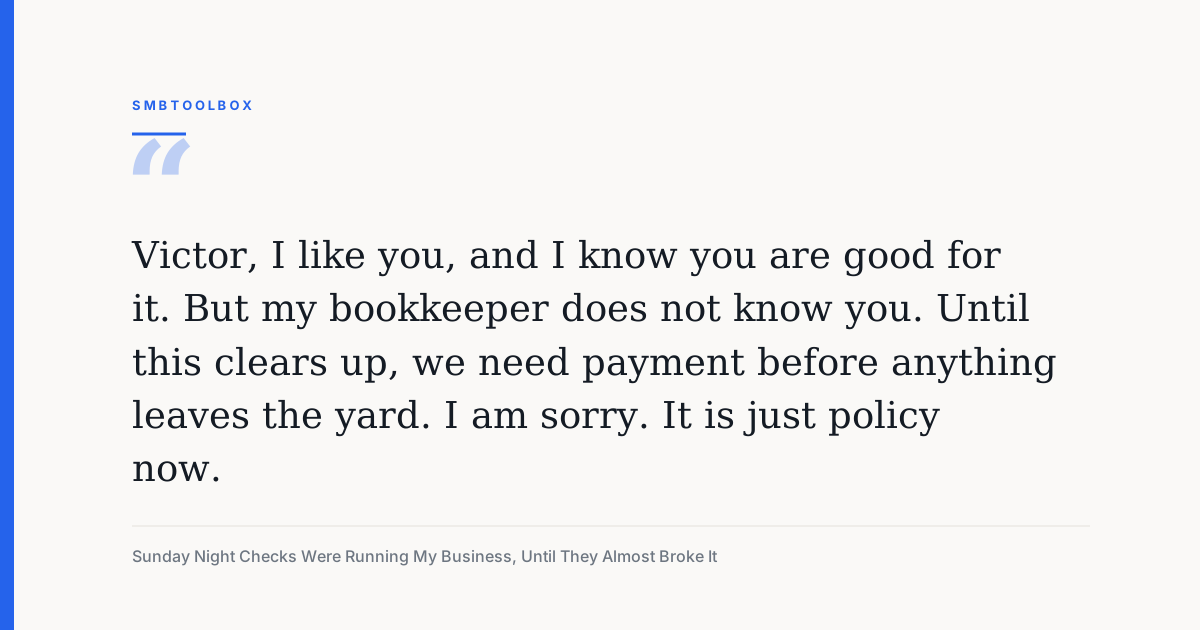
Victor, I like you, and I know you are good for it. But my bookkeeper does not know you. Until this clears up, we need payment before anything leaves the yard. I am sorry. It is just policy now.
Prepay. On my biggest supplier. In April. I stopped payment on the lost check, paid a fee for that privilege, and drove a new check forty minutes to their office. The worst part was not the money. It was realizing that six years of on-time Sunday-night checks had built me exactly zero proof that I paid on time. All my reliability lived in envelopes.
What I Tried First
I did not find the right answer right away. Over the next month I tried the obvious fixes, and each one failed in its own way.
- My bank's bill pay. It mailed paper checks on my behalf with no invoice details attached, so my supplier's bookkeeper got payments she could not match to invoices. That made the trust problem worse, not better.
- Putting everything on the business card. A few vendors took cards, most did not, and the ones that did passed along processing fees. Eating three percent just to avoid stamps was a bad trade.
- Hiring a bookkeeper to handle payables. I got two quotes. Both were fair prices, and both were more than I could justify for a company my size, at least in-season when cash is tight.
Finding Melio
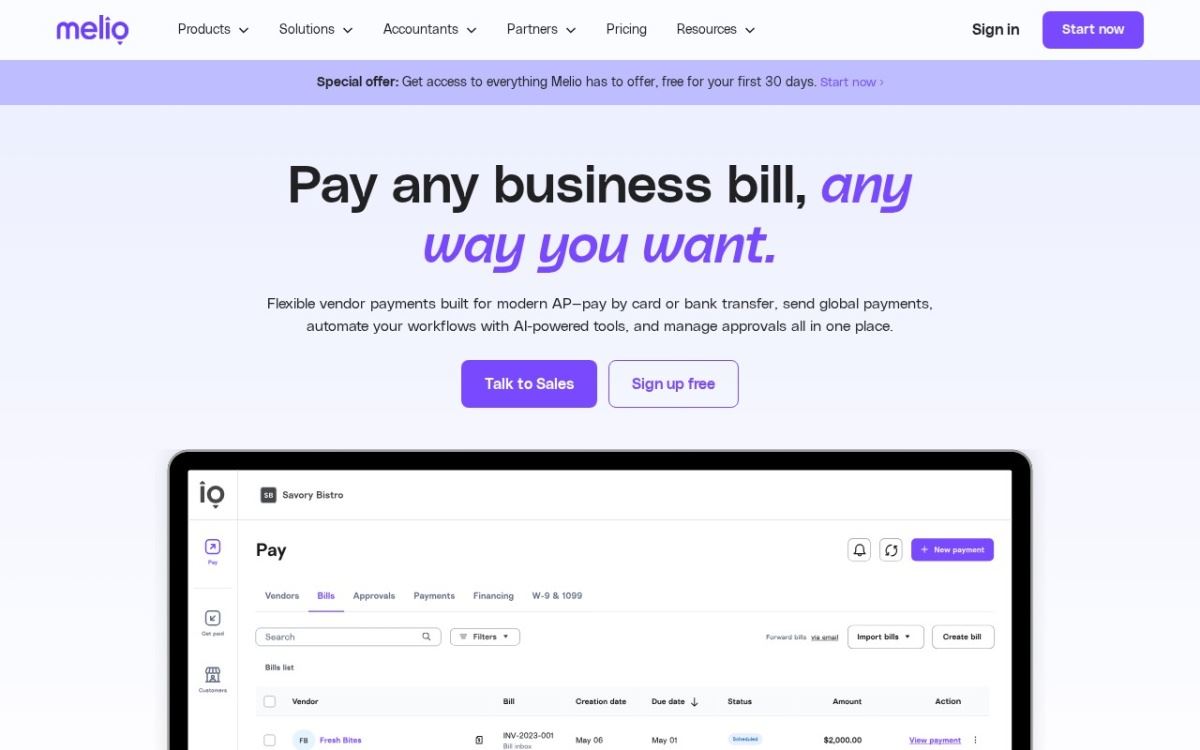
The fix came, like most things in my life, from another contractor. A paving guy I sub for saw me writing checks in my truck and asked why I was not using Melio. His pitch was one sentence: you pay bills online, bank transfers are free, and the vendor gets paid however they want to get paid. That last part is what got me. My vendors did not have to sign up for anything. Melio sends them a bank transfer or a paper check on my behalf, with invoice details attached, and I stop touching envelopes.
Setting it up took an evening, not a weekend. I connected the business checking account, snapped photos of the bills in my folder, and Melio pulled the amounts and due dates off them. It syncs with QuickBooks Online, so every payment lands in the books without me typing it twice. Two features mattered more than I expected. First, I can pay by card even when a vendor only takes checks or bank transfers, because Melio charges my card and delivers the payment in the form the vendor wants. In early spring, when money goes out weeks before it comes in, buying thirty days of float on a big nursery bill is worth the card fee. Second, every payment has a trail: scheduled this date, delivered that date, tied to this invoice. When a bookkeeper has a question now, my answer is not a story about the mail.
My New Routine
Bills still come in all week, by email and on paper. I photograph the paper ones from the truck and forward the emailed ones to Melio, and that is the whole filing system. On Friday afternoon, I spend about fifteen minutes on my phone approving and scheduling the week's payments. Recurring vendors are set up once and just run. Bigger bills get scheduled for the date they are actually due instead of whenever I had stamps, so money stays in my account days longer. Sunday nights at the kitchen table are now for the crossword and the beer I actually finish.
What Actually Changed
I will not pretend to have precise numbers, because I did not measure my old chaos. But some things are plainly different. The nursery took me off prepay a couple of months after I switched, once a steady run of on-time, clearly labeled payments rebuilt their trust. Late fees have basically disappeared, because payments are scheduled the day the bill arrives instead of remembered on Sunday. For the first time, I can see three weeks of outgoing money on one screen, which changed how I bid jobs in the tight months. The biggest change is dumber than all of that: I got my Sunday nights back, and my wife noticed before I did.
The Honest Fine Print
Melio is not free money. Bank transfers cost nothing, but paying by card carries a processing fee, so the cash-flow trick I described is a paid feature, and you should do the math before leaning on it. Faster delivery options also cost extra. And it is built for paying US vendors from a US business, so if your suppliers are overseas, this is not your tool. None of that changed my mind. I pay the card fee a few times a year, on purpose, when the float is worth more than the fee. The rest of the time I pay nothing.
If You Are Still at the Kitchen Table
My system is not fancy. It is a free account, a phone camera, and fifteen minutes on Fridays. But a lost envelope should not be able to put your biggest supplier relationship at risk, and mine could, for six years, without me ever thinking about it. If your accounts payable department is a checkbook and a book of stamps, it is not costing you nothing. It is just billing you in ways you have not added up yet.
Disclosure: This post reflects my own experience running a small landscaping company. SMBToolbox may earn a commission if you sign up through links on this site, at no cost to you. Nobody paid me to tell this story, and the lost check, unfortunately, was real. - Victor
Community discussion
Enjoyed this story? Share your thoughts below.