
Prop firm ads are everywhere right now, and almost all of them show you the same thing: a payout screenshot and a number with a lot of zeros. Almost none of them explain what you are actually buying, who the counterparty is, or what happens in the far more likely scenario where things do not go your way. So before I walk through Blue Guardian specifically, I want to explain the model itself - because if you understand the business you are buying from, you will make a much better decision about whether to buy at all.
First: what a prop firm challenge actually is
You are not applying for a job, and you are not investing. You are paying a one-time fee to take an assessment on a simulated trading account. If you hit the profit target without breaking the drawdown rules, the firm gives you a funded account - typically also simulated - and pays you a share of the profits your trading produces on it. If you break a rule, the account is closed and the fee is gone.
That last sentence is the whole model, and it is worth reading twice. A prop firm's revenue comes primarily from challenge fees. Their customers are traders, not markets. That does not make the model illegitimate - plenty of firms pay out reliably and publish their numbers - but it does mean the incentives are not a broker's incentives, and you should read the rulebook like a contract rather than a brochure. Because it is one.
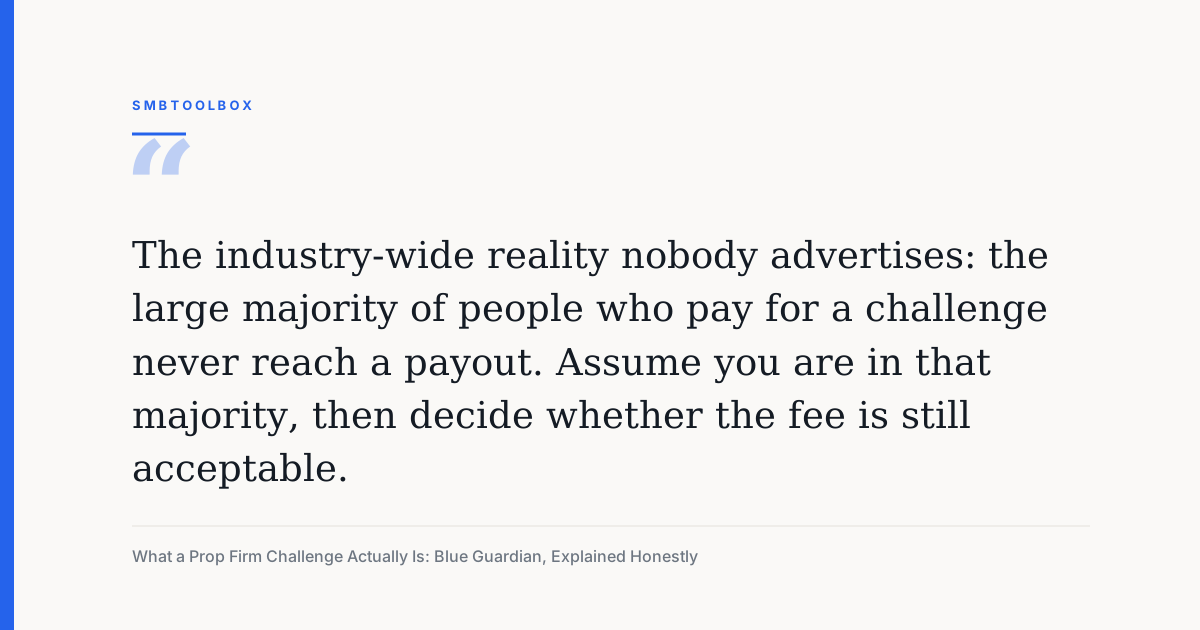
The industry-wide reality nobody advertises: the large majority of people who pay for a challenge never reach a payout. Assume you are in that majority, then decide whether the fee is still acceptable.
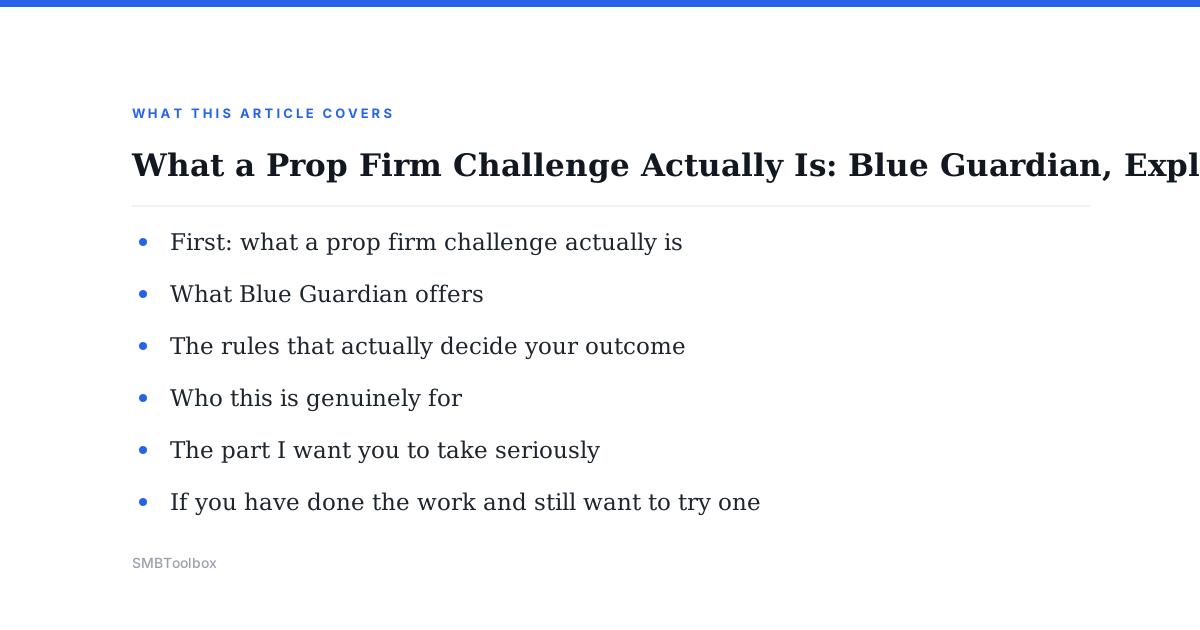
What Blue Guardian offers
Blue Guardian is one of the larger firms in this space, operating across 170+ countries with support for both CFD and CME-listed futures trading, seven-plus trading platforms, and 24/7 support. Publicly they show 4.6/5 on Prop Firm Match and 4.9/5 on Google, which sits on the better end of the sector - though a firm's average rating tells you nothing certain about your own account.
The account types, in plain English
- Instant - no evaluation at all. You pay, you are funded immediately, with on-demand payouts and up to a 90% profit split. Highest upfront cost, nothing to pass.
- 1 Step - a single profit target to hit before funding. The cheapest single-phase route, with payouts on a 7-day cadence.
- 2 Step - two phases with easier targets and more breathing room, for people who want less pressure in each phase.
- Futures plans (Standard, Reserve, Express, Direct) - these differ mainly in payout cadence and daily-loss-limit rules. Express advertises daily payouts with an $1,100 daily cap; Reserve offers a version with no daily loss limit; Direct skips evaluation with the profit split scaling 20% to 25% to 30% as you stay consistent.
What it costs
Account sizes run from 5K up to 400K, with fees from roughly $54 for the smallest to about $2,200 for the largest. There is a promotional code (BG25) advertising 25% off, and they offer a buy-now-pay-later option. Treat that last feature with real caution: financing a speculative trading fee is how a bad month quietly becomes a debt.
The rules that actually decide your outcome
Everyone reads the profit split. Almost nobody reads the drawdown rules - and the drawdown rules are what close accounts. Before paying anything, find and understand these four things on the firm's own site:
- Maximum drawdown - the most your balance can fall before the account is terminated, and whether it is measured from your starting balance or trails your highest balance.
- Daily loss limit - some plans have one, some do not, and it is often the single most common reason accounts fail. Blue Guardian advertises no daily loss limit on the $25K Standard futures size, and a no-DLL option on Reserve.
- Payout cadence and caps - how often you can withdraw and the maximum per withdrawal. A 90% split on a capped payout is a different product than it first sounds like.
- Consistency and news-trading rules - whether one outsized winning day can disqualify you, and whether trading through news events is permitted. Express advertises that news trading is allowed; not every plan at every firm does.
Who this is genuinely for
A prop challenge makes sense for one specific person: a trader who already has a tested, documented strategy, who has been consistently profitable on their own smaller capital, and who wants access to larger size without risking their savings. For that person, a few hundred dollars for a shot at trading a 100K account is a rational bet with a known maximum loss.
It makes no sense at all for someone still learning to trade. If you are not yet profitable on your own money, paying a fee to trade someone else's - under stricter rules and time pressure - does not fix the underlying problem. It just puts a deadline on it. The honest advice is unglamorous: get consistent on a small live account first, then consider a challenge.
The part I want you to take seriously
Only risk a fee you can lose without it affecting your life. Never finance it. Understand that a funded account is generally a simulated account with a profit-sharing agreement - not employment, and not an investment product. Read the refund policy and terms before you purchase, not after. And treat any content that leads with payout screenshots - including affiliate content - as marketing rather than evidence about your likely outcome. Nothing here is financial advice; for a decision that matters to your finances, talk to a licensed professional rather than a website.
If you have done the work and still want to try one
If you are the specific person described above - already consistent, clear on the rules, using money you can afford to lose - Blue Guardian is one of the better-reviewed firms in the category, with a wide spread of account structures across both CFD and futures. Read the funded rules page in full first, then pick the smallest account size that still lets you trade your actual strategy.
Disclosure, in plain terms: this article contains an affiliate link, and SMBToolbox may earn a commission if you purchase through it, at no extra cost to you. That is exactly why the risk section above is as blunt as it is - no commission is worth pointing a reader into a loss they did not understand they were taking. Trading involves substantial risk of loss and is not suitable for everyone. - Tom
Community discussion
Enjoyed this story? Share your thoughts below.